Fujikura CT-04B High-Precision Fiber Cleaver
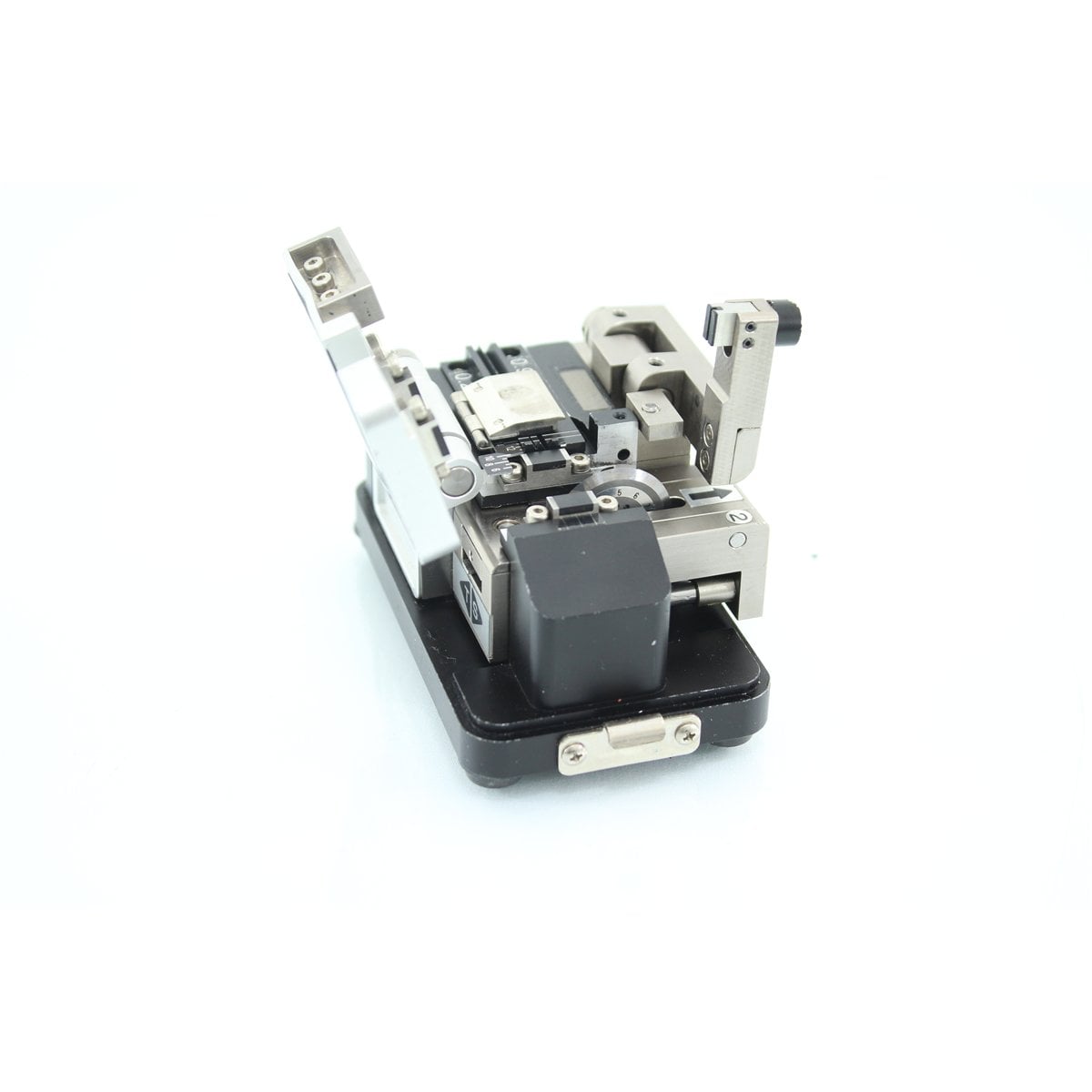
The Fujikura CT-04B is a high-precision fiber cleaver designed to prepare telecommunications optical fibers for fusion splicing and related fiber assembly processes. It is intended for glass fibers with a nominal cladding diameter of 125 µm and can accommodate multiple coating diameters and cleave-length requirements when equipped with the appropriate optional fiber plate or fiber holder.
The CT-04B uses a sliding circular blade to score the fiber, followed by an anvil and fiber-breaking mechanism that completes the cleave. This controlled process helps produce the clean, consistent fiber end face required for accurate alignment and dependable fusion-splicing performance.
Optional fiber plates support coated fibers with diameters from 250 µm to 900 µm, depending on the selected configuration. A compatible fiber holder can also be used for ribbon fiber preparation. This versatility makes the CT-04B suitable for single-fiber and multifiber workflows in telecom installation, fiber optic production, laboratory research, component assembly, maintenance, and repair environments.
Features and Benefits of the Fujikura CT-04B
The Fujikura CT-04B provides practical value for professional users who require controlled and repeatable optical fiber preparation.
- High-precision construction: Provides the mechanical alignment and controlled cleaving action required for professional fiber optic preparation.
- 125 µm fiber compatibility: Designed for telecommunications glass fibers with a nominal cladding diameter of 125 µm.
- Single-fiber preparation: Supports compatible coated fibers when configured with the appropriate optional fiber plate.
- Ribbon fiber capability: Can cleave compatible ribbon fibers using a suitable fiber holder.
- Sliding circular blade: Scores the optical fiber through a controlled linear movement.
- Mechanical fiber-breaking process: Uses an anvil and breaking button to complete the cleave after the fiber has been scored.
- Multiple cleave lengths: Supports cleave lengths ranging from 6 mm to 20 mm in compatible plate configurations.
- Replaceable blade positions: The circular blade can be rotated to expose a new cutting position when the active position becomes worn.
- Compact manual operation: Does not require electrical power, software, or a separate control system.
- Fusion-splicing preparation: Produces fiber end faces suitable for loading into compatible fusion splicers.
- Serviceable wear components: Allows routine cleaning and indexing of the circular blade.
- Professional application range: Suitable for field service, laboratory, production, telecom, and fiber optic assembly workflows.
High-Precision Fiber Preparation
Fiber cleaving is a critical preparation step before fusion splicing. A properly prepared end face helps the fusion splicer inspect, position, align, and join the fibers. Irregular angles, chips, cracks, contamination, and damaged fiber ends can result in rejected splice attempts or increased optical loss.
The Fujikura CT-04B controls the scoring and breaking process through a guided blade unit, fiber clamp, anvil, and breaking mechanism. The operator secures the prepared fiber in the cleaver, slowly slides the blade unit to score the glass, lowers the anvil, and presses the fiber-breaking button to complete the cleave.
Actual cleave quality depends on the condition of the blade, elastomer clamp pad, fiber coating preparation, fiber cleanliness, plate selection, fiber positioning, and operator technique. Routine inspection and cleaning are important for maintaining consistent results.
Sliding Circular Blade Mechanism
The CT-04B incorporates a circular cleaving blade mounted in a sliding blade unit. After the fiber is positioned parallel to the alignment markings and secured by the clamp, the operator moves the blade unit slowly in the indicated direction.
This movement scores the surface of the glass fiber. The fiber is then broken by lowering the anvil and depressing the dedicated breaking button. The clamp unlocks automatically after the breaking action is completed.
The blade should be moved slowly and evenly. Excessive force, abrupt movement, or contact with the blade edge can damage the cleaver, affect the fiber end face, or create a safety hazard.
Fiber Alignment and Clamping
Alignment markings on the cleaver help the operator position the optical fiber properly before scoring. The fiber should be placed parallel to these markings and seated correctly in the selected plate or holder.
When preparing ribbon fiber, the individual fibers should remain arranged in parallel and must not cross one another. Crossed, twisted, or incorrectly positioned fibers can produce uneven cleaves across the ribbon.
The clamp uses an elastomer pad to hold the fiber during blade movement and the final breaking action. Contamination or wear on the pad can affect fiber retention and cleave consistency. The pad should be inspected and cleaned regularly using appropriate materials.
Compatible Optional Fiber Plates
The Fujikura CT-04B supports several optional fiber plates for different coating diameters and cleave-length requirements. Selecting the correct plate helps position the fiber at the required distance from the blade and breaking mechanism.
The Fiber Plate 03 supports coated fibers from 250 µm to 900 µm and provides a documented 16 mm cleave length. The Fiber Plate 03AT supports the same coating range with a 12.5 mm cleave length.
The Fiber Plate 04 and Fiber Plate 07 support fibers with a 250 µm coating and provide adjustable cleave lengths from 6 mm to 20 mm. Another documented plate configuration supports 900 µm coated fibers with cleave lengths from 10 mm to 20 mm.
Plate availability and included components vary among individual cleavers. Buyers should confirm the plate model installed on the CT-04B and verify that it matches the intended fiber and fusion-splicing process.
Ribbon Fiber Cleaving
The CT-04B can prepare compatible ribbon fibers when used with a suitable fiber holder. The documented ribbon fiber configuration provides a 10 mm cleave length.
During ribbon preparation, the fibers must remain parallel and correctly arranged. Individual fibers should not overlap or cross before the clamp is closed. The fiber holder must position the ribbon securely and present all fibers consistently to the circular blade.
The maximum supported ribbon count, ribbon dimensions, coating construction, and holder compatibility depend on the specific fiber holder. These details should be verified before the cleaver is used for a mass-fusion splicing application.
Circular Blade Indexing
The circular blade provides multiple usable cutting positions around its circumference. If cleave quality becomes inconsistent after cleaning, the blade can be rotated by one-twelfth of a turn to expose the next cutting position.
Blade indexing requires loosening the blade-locking screw, rotating the blade until the next hole aligns with the screw position, and securing the blade again. The cutting edge should never be touched during this procedure.
Only the blade-locking screw associated with the documented indexing procedure should be adjusted by the operator. Other precision screws and mechanical adjustments should not be loosened or modified because the cleaver is aligned during manufacturing.
Cleaning and Routine Maintenance
The circular blade and elastomer clamp pad should be cleaned frequently. Contamination from fiber coatings, cleaning residue, dust, or broken glass can interfere with scoring, clamping, and fiber separation.
The documented maintenance procedure specifies cleaning the blade and elastomer pad with cotton dampened with ethyl alcohol. The cleaver should be kept free of loose fiber fragments, dirt, oil, and abrasive material.
If cleaning does not restore acceptable cleaving performance, the next blade position can be selected. If all available blade positions are worn or the cleaver remains inconsistent, further blade service or professional mechanical inspection may be required.
Typical Applications
The Fujikura CT-04B Fiber Cleaver is suitable for professional applications such as:
- Single-mode fiber preparation
- Multimode fiber preparation
- Fusion-splicing workflows
- Ribbon fiber cleaving with a compatible holder
- Fiber optic cable installation
- Telecommunications network maintenance
- Outside-plant fiber restoration
- Fiber optic component assembly
- Laboratory fiber preparation
- Production and manufacturing processes
- Fiber optic repair and technical service
- Training and educational laboratories
Product Overview
| Brand |
Fujikura |
| Model |
CT-04B |
| Product Category |
High-Precision Optical Fiber Cleaver |
| Applicable Fiber Material |
Telecommunications optical glass fiber |
| Nominal Fiber Cladding Diameter |
125 µm |
| Primary Fiber Configuration |
Single fiber with optional ribbon fiber capability |
| Cleaving Blade |
Circular blade with indexable cutting positions |
| Cleaving Method |
Sliding blade score followed by anvil-assisted mechanical separation |
| Power Requirement |
None, manually operated |
| Primary Application |
Precision fiber preparation before fusion splicing |
Fiber Plate and Cleave Length Options
| Fiber Plate or Holder |
Supported Fiber |
Documented Cleave Length |
| Fiber Plate 03 |
250 µm to 900 µm coated fiber |
16 mm |
| Fiber Plate 03AT |
250 µm to 900 µm coated fiber |
12.5 mm |
| Fiber Plate 04 |
250 µm coated fiber |
6 mm to 20 mm |
| Fiber Plate 07 |
250 µm coated fiber |
6 mm to 20 mm |
| 900 µm Plate Configuration |
900 µm coated fiber |
10 mm to 20 mm |
| Compatible Ribbon Fiber Holder |
Ribbon fiber |
10 mm |
Cleaver Components
| Component |
Function |
| Fiber Clamp |
Secures the optical fiber during scoring and separation |
| Elastomer Clamp Pad |
Provides contact and retention for the loaded fiber |
| Sliding Blade Unit |
Moves the circular blade across the fiber to create the initial score |
| Circular Blade |
Scores the glass surface before the fiber is separated |
| Blade-Locking Screw |
Secures the selected circular blade position |
| Anvil |
Supports the controlled fiber-breaking process |
| Fiber-Breaking Button |
Completes the cleave after the fiber has been scored |
| Parallel Alignment Markings |
Assist with straight fiber placement before clamping |
| Interchangeable Fiber Plate |
Positions compatible coating diameters for the required cleave length |
Operating Considerations
The correct fiber plate or holder should be installed before the cleaving process begins. The prepared fiber must be positioned parallel to the alignment markings and seated securely before the clamp is closed.
The blade unit should be returned to its starting position before a fiber is loaded. After the clamp is secured, the blade unit should be moved slowly in the marked direction. The anvil is then lowered and the breaking button is pressed until the clamp releases.
The CT-04B is designed exclusively for telecommunications optical glass fibers. It should not be used to cut wire, plastic, metal, or other materials because improper use can damage the precision blade and mechanical components.
The circular blade is sharp and must not be touched. Safety glasses should be worn during preparation, and glass fiber fragments should be placed in an appropriate disposal container immediately after cleaving.
Fusion Splicer Compatibility Considerations
A suitable cleave length is determined by the fusion splicer, fiber holder, fiber clamping method, and coating configuration. The optional plate installed on the CT-04B must therefore match the requirements of the intended splicer.
Shorter cleave lengths may be required for coating-clamp specialty fiber splicers, while longer lengths may be used with conventional bare-fiber clamping systems. Ribbon fiber preparation requires a holder that maintains the correct fiber arrangement and length.
Before purchasing or configuring the cleaver, users should confirm the splicer model, fiber cladding diameter, coating diameter, fiber count, holder type, cleave length, and plate compatibility.
Comprehensive Functional and Performance Testing
The Fujikura CT-04B receives comprehensive functional and performance testing before shipment. Testing may include inspection of the chassis, clamp, elastomer pad, sliding blade unit, circular blade, blade-locking screw, anvil, breaking button, alignment markings, and installed fiber plate.
Mechanical testing may include movement of the blade carriage, clamp engagement and release, anvil operation, breaking-button function, blade indexing, and verification that the installed plate remains properly seated.
When suitable test fibers are available, evaluation may include stripping, cleaning, loading, scoring, and cleaving compatible 125 µm cladding fibers. The resulting end faces may be inspected with appropriate fiber-viewing or fusion-splicer imaging equipment to assess cleave consistency.
Ribbon fiber testing may be performed when a compatible ribbon holder and multifiber sample are available. The exact test configuration, installed plate, coating diameter, fiber type, holder model, blade position, and cleave-evaluation method should be confirmed when these details are important to the buyer’s process.
Buyer Considerations
Buyers should confirm the fiber plate or holder installed on the Fujikura CT-04B. The cleaver’s practical coating compatibility and available cleave length are determined by this component.
The circular blade, blade-position history, elastomer pad, clamp, sliding carriage, anvil, breaking button, alignment markings, and fiber plate should be inspected for wear, contamination, damage, corrosion, or missing parts.
Optional Fiber Plates 03, 03AT, 04, and 07, ribbon fiber holders, replacement blades, tools, carrying cases, fiber scrap containers, and other accessories should not be considered included unless specifically identified in the product listing.
The CT-04B is a precision mechanical tool. Unauthorized adjustment of factory-aligned screws or structural components can reduce cleave quality and may require professional realignment.
Why Buy from AssetRelay?
AssetRelay supplies professional equipment and product solutions for fiber optic installation, telecom network deployment, fusion splicing, laboratory testing, production, inspection, cleaning, electronic test, RF/microwave, and photonics applications. The Fujikura CT-04B supports installers, technicians, laboratories, manufacturers, service organizations, and training facilities that require controlled optical fiber preparation.
Buyers should review the available product photographs, physical condition, installed fiber plate, blade condition, clamp operation, anvil movement, breaking mechanism, included holders, accessories, and testing information before purchase.
Only the cleaver, fiber plates, holders, tools, replacement components, case, documentation, and accessories specifically identified in the individual product listing should be considered included.





 Download the Fujikura CT-04B Specification Sheet (PDF)